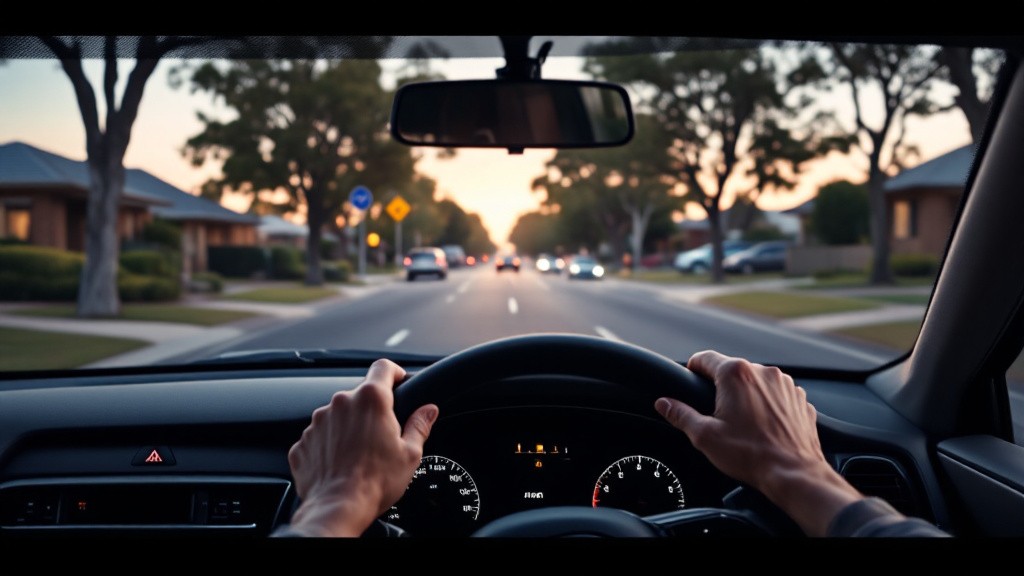
The NSW Driver Knowledge Test in one minute
The NSW Driver Knowledge Test has 45 questions, and the pass rule is the single most misunderstood thing about it. You must clear both section minimums: 12 of 15 general knowledge AND 29 of 30 road safety, per Transport for NSW. Scoring 41 of 45 overall is necessary but NOT sufficient: you can hit 41 and still fail if either section falls short. The test ends immediately at 4 wrong in general knowledge or 2 wrong in road safety, so every road safety question matters. These figures come from Transport for NSW's Driver Knowledge Test page. Read it before you book.
Free NSW DKT practice by licence class
Three kinds of set prepare you in three ways. Topic sets drill one subject until it sticks. Practice tests put you in the real test's 45-question shape. Mock tests are sat under test conditions so the pressure is familiar before the real thing. Car, motorbike and heavy-vehicle candidates each have their own bank, and all of them are free. On this site: car has 12 topic sets (366 questions), 9 practice tests (405) and 8 mock tests (360); motorbike has 12 topic sets (549 questions), 13 practice tests (585) and 8 mock tests (360); truck has 14 topic sets (365 questions), 9 practice tests (405) and 8 mock tests (360). Pick your licence class and start where you are weakest. If you have never sat one, open a full practice test first to see the real shape, then come back to the topic sets for the subjects you dropped marks on. Riders can jump straight to the motorbike DKT practice, and heavy-vehicle candidates to the truck DKT practice.
Practice Test 1
Practice Test 2
Practice Test 3
Practice Test 4
Practice Test 5
Practice Test 6
Practice Test 7
Practice Test 8
Practice Test 9
Mock Test 1
Mock Test 2
Mock Test 3
Mock Test 4
Mock Test 5
Mock Test 6
Mock Test 7
Mock Test 8
Topic, then practice, then mock
Work in three moves, in order. The sequence is what fixes weak subjects instead of hiding them.
- 1
Sit one practice test cold
Open a 45-question practice test with no revision first. Your wrong answers show exactly which subjects to drill.
- 2
Two topic sets a day on the weak subjects
Work the subjects you dropped marks on, and start with the three biggest: General Knowledge (82 questions), Intersections (54) and Traffic Signs (51). Two sets a day keeps it steady.
- 3
Move to mock tests under test conditions
Sit mock tests quietly with no notes. Keep going until a result clears BOTH section minimums — not just the overall total. The section rule is what fails people, so watch the general knowledge and road safety splits, not the headline score.
- 4
Repeat the weak section
If road safety keeps slipping, drill those topic sets again before your next mock. Clean mocks on both sections mean you are ready to book.
In person or online: the two ways to sit it
You can sit the NSW DKT in person at a service centre or online at home. The online DKT is an interactive 4–6 hour self-paced course and test you complete yourself; the in-person test is sat at the counter. In person it is $58 each attempt, per Transport for NSW. Online it is $58 for unlimited attempts, so if you fail the online final test you can retake it after 12 hours without paying again. On age: you must be 16 or older to sit in person, and you can enrol in the online DKT at 15 years and 11 months, but you can only apply for a learner licence from 16, and the learner licence is $32. Fees effective 1 July 2026. Confirm the current fees on the Transport for NSW fees page before you pay, as they are reviewed each July.
In person
Sat at a service centre. $58 each attempt. You must be 16 or older.
Online
Interactive 4–6 hour self-paced course and test at home. $58 for unlimited attempts; retake 12 hours after a fail. Enrol from 15 years 11 months.
The two sections the pass rule is built on
The test is built on two sections, and they are the same two the pass rule is built on: general knowledge and road safety. General knowledge covers the rules of the road, licensing and vehicle basics; road safety covers the choices that keep you and others safe, which is why its minimum is the strictest, at 29 of 30. Underneath those sections sit the subjects you practise here: General Knowledge, Intersections, Traffic Signs, Traffic Lights & Lanes, Negligent Driving and Pedestrians, among others. Each maps to a topic set on this page, so when a mock shows you are weak on intersections you can drill that exact subject. The study document is the Road User Handbook. Read the relevant chapter, then practise the matching topic set until your answers are automatic. If you are new to the whole process, start with the learner test explained, then come back and drill subjects.
These are NSW's own questions
These are NSW's own questions for NSW's own test. The bank is the Driver Knowledge Test bank that Transport for NSW publishes, and the study document behind it is the Road User Handbook, so the wording you practise is the wording you meet. Anyone sitting the NSW test can use the figures at the top of this page exactly as they stand. If you are a learner in another state practising here, the rules overlap heavily across Australia, so the recall still transfers; what does not transfer is the paperwork. Your own transport authority sets your test, its question count, its pass mark and its fee, so take those from it before you book. Northern Territory learners can start at start on the NT page, which covers that jurisdiction's own path and its free practice.
Hazard perception comes next
After you pass the DKT, the Hazard Perception Test is the next step, and it works differently. You cannot sit the practical Driving Test until you have passed it. It uses 15 short videos in which you respond to developing hazards, so there is no handbook of right answers to memorise and practice matters more than cramming. It is $58 each attempt, with unlimited attempts and the fee payable each time, per Transport for NSW. Train on the clips until your timing feels natural rather than chasing a score; the clip practice on this site is at practise the hazard perception clips. Once you pass the HPT you must pass the Driving Test within 15 months, or the result lapses and you sit the clips again. Book the hazard test for the same fortnight as your drive and those 15 months never become a problem. Read the official Hazard Perception Test page from Transport for NSW for the current booking rules.
Booking and test day
Book your NSW tests through Service NSW or myRTA, and bring the identity documents the authority lists so your booking is not turned away at the counter. If you are also booking the practical Driving Test, it is $72 inc GST each attempt, per Transport for NSW. Check what identity documents you need on the Transport for NSW pages before you travel, as the exact list depends on what you already hold. Keep the booking simple: confirm the time, bring your ID, and arrive early.
The seven days before your test
A week is enough if you work the sets in order.
- 1
Day 1 — sit a practice test cold
Open Practice Test 1 with no revision and note every wrong subject.
- 2
Days 2–3 — drill general knowledge
Work the General Knowledge and Traffic Signs topic sets, two a day.
- 3
Days 4–5 — drill road safety
Work Negligent Driving, Pedestrians and Intersections topic sets — the road safety minimum is the strictest at 29 of 30.
- 4
Day 6 — a full practice test again
Re-sit a 45-question practice test and check both section splits, not just the total.
- 5
Day 7 — Mock Test 1 under test conditions
Sit Mock Test 1 quietly with no notes. A clean result on both sections means you are ready to book.
Official sources
The rules on this page follow the official requirements published by Transport for NSW Driver Knowledge Test page; Transport for NSW fees page; Hazard Perception Test page from Transport for NSW. Always confirm current rules and fees with the authority before you book.