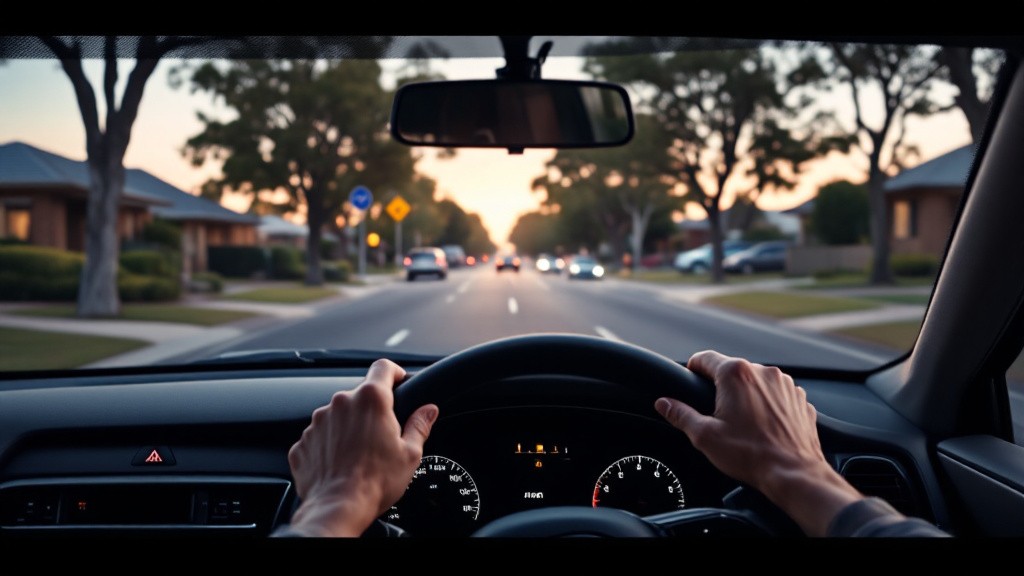
Forty-five mixed questions, in one go
A car practice test is the real test's shape rather than a lesson. Forty-five questions, every subject mixed together, marked at the end so the result tells you something you did not already know. You can take your time over it, and that is the one way it differs from a mock. The real Driver Knowledge Test is also 45 questions, set by Transport for NSW, and it is marked in two parts. General knowledge is 15 questions and 12 must be right. Road safety is 30 questions and 29 must be right. Both minimums apply, which is why 41 of 45 overall is necessary but not sufficient. The real test can also stop before you reach the end: four wrong in general knowledge, or two wrong in road safety, and it finishes there. A practice test is where you find out whether either of those is likely, at a point where it still costs you nothing but an evening.
The loop that makes nine sets worth nine sets
Sit the first set with no revision at all. A cold result is information; a prepared result is flattery. Write down the subject behind every question you miss, because that list is your study plan and nothing else is. Then take those subjects to car practice, where each set holds every question in one subject, and work them until the rule arrives before the options do. Come back to a different practice test afterwards. Nine sets exist so that you always have a fresh one, and a fresh set is the only honest check. Run that loop until two sets in a row come back clean in both sections. At that point the mocks are worth your time.
- 1
Take Test 1 with no revision
A cold result shows you where you really stand.
- 2
Write down the missed subjects
The subjects behind your wrong answers are the study list.
- 3
Fix them one subject at a time
Work each weak subject on car practice until the rule comes first.
- 4
Come back to a different set
A fresh test checks whether the subject held in a mixed sitting.
- 5
Never re-run a set you have seen
Repeating one set teaches its answers, not the road rules.
The nine car practice tests here
There are 9 car practice tests on this page. Each one holds 45 questions, the same length as the real test, which makes 405 questions in total. They are drawn from the same NSW-based bank, and the numbering is an order to work through rather than a difficulty ladder. Every set is free and you can re-sit any of them as often as you like. The useful discipline is the opposite of re-sitting, though: work forward through the numbers so that every result is a fresh measurement rather than a memory test. Pick a set below and start.
Practice Test 1
Practice Test 2
Practice Test 3
Practice Test 4
Practice Test 5
Practice Test 6
Practice Test 7

Practice Test 8
Practice Test 9
The two sections your result has to clear
The real test is not one score out of 45. It is 15 general knowledge questions and 30 road safety questions, marked separately, and each part carries its own minimum (Transport for NSW). Road safety is the tighter half by a long way, because one wrong answer out of 30 is the entire allowance. So read every practice test the same way. Count the general knowledge misses, then count the road safety misses, and treat a single road safety miss as the warning it is rather than as rounding. The questions themselves mix the whole subject list, and the subjects are not the same size. General Knowledge is the largest at 82 questions in the bank. Every subject and its size is listed on car practice, which is also where you go to drill one.
15 general knowledge questions
One of the two parts the real test is marked in.
30 road safety questions
The larger part, and the one with almost no margin.
Both minimums, not one total
Clearing one section does not cover a miss in the other.
41 of 45 is not a pass by itself
A high total that misses a section minimum is still a fail.
Four wrong ends general knowledge
The real test stops there, before question 45.
Two wrong ends road safety
The same rule, with a much smaller margin for error.
Why a strong total can still be a fail
The arithmetic catches people out. Miss four general knowledge questions and the test is over, whatever your road safety answers would have been. Miss two in road safety and the same thing happens. Either of those can occur while your overall tally still looks like a comfortable pass. So judge a practice test the way the real one is judged. Two clean sections, twice in a row, is the signal to book. A high percentage with one soft section is not, and it is the most common reason a confident learner comes away surprised. The score shown after a set here is a tally of the answers you gave on this page. It is not an official result and it neither books nor replaces the real test.
Mocks next, and the hazard clips after that
When two practice tests in a row come back clean in both sections, move to the mock tests. There are 8 of them, 45 questions each, sat in one go with nothing looked up. If a subject is still biting, drill it on car practice before you spend an evening on a mock. The Hazard Perception Test is the step after the knowledge test: 15 short videos, $58 for each attempt, with unlimited attempts, and once you pass it the driving test must be passed within 15 months (Transport for NSW). The clips are at practise the hazard perception clips, and there is no reason to wait until the knowledge test is behind you before you start on them. The bank behind every set here is NSW-based. The test is run by each state's own authority, Transport for NSW in New South Wales, TMR in Queensland, VicRoads in Victoria, the Department for Infrastructure and Transport in South Australia, the Department of Transport in Western Australia, and the MVR in the Northern Territory. If you are sitting it in the Northern Territory, see our Northern Territory page.
Official sources
The rules on this page follow the official requirements published by Transport for NSW Driver Knowledge Test; Driver and rider licence fees; Hazard Perception Test. Always confirm current rules and fees with the authority before you book.