Practise the clips here, free
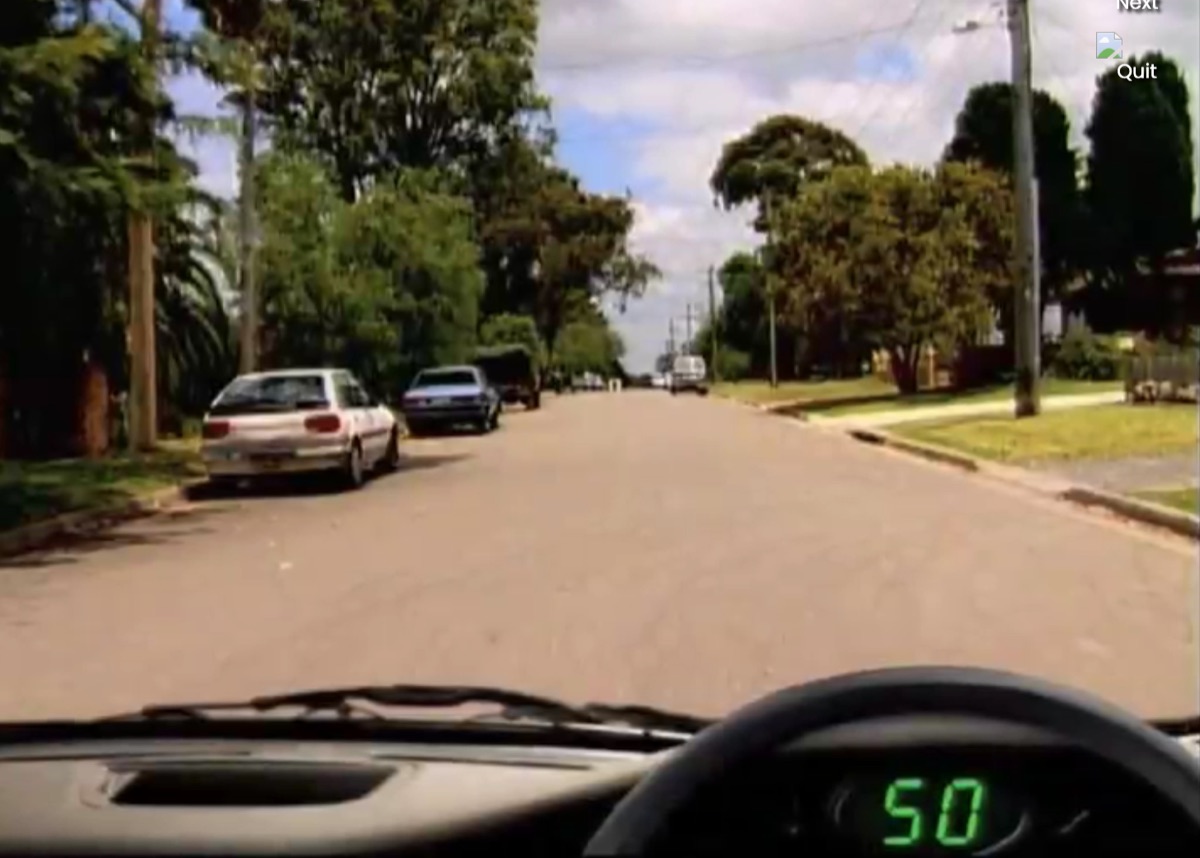
The clips on this page are the same kind the test plays: a scene develops, and you respond when a safe driver would. Free clips need no account. Premium clips sit in the course. Use them the right way and they build the reflex the test checks, not just familiarity with a handful of scenes.
- 1
Watch a clip cold
Play it once without knowing what happens, and respond when you feel a safe driver would act.
- 2
Read why the moment was the moment
Check the explanation for when the hazard became a developing hazard, not just a thing on the road.
- 3
Repeat the ones you missed
Replay the clips where your timing was early or late until the response feels natural.
- 4
Mix the clip types
Shuffle intersections, parked-car corridors, and multi-lane scenes rather than running them in order, so you are not predicting from memory.
- 5
Save your progress
An account at save which clips you have cleared remembers which clips you have cleared; premium practice lives at premium practice when you want more scenarios.
The hazard perception test, in one screen
In New South Wales the hazard perception test is 15 short videos, and you watch each one and respond when a developing hazard means a safe driver would act. Transport for NSW charges $58 each attempt (2026); if you do not pass, you may sit it again as many times as you need, paying the fee each time. Once you pass, you then have 15 months to pass the Driving Test, or the pass lapses and you pay again. Transport for NSW sets the standard for the result, so aim for timing that stays steady on clips you have not seen before.
What the test is actually measuring
Knowing the road rules and spotting a hazard in time are two different skills, and this test checks the second one. A static hazard is already there and obvious: a parked car, a sign, a stopped bus. A developing hazard is a situation changing in front of you — a pedestrian stepping off a kerb, a car edging out of a side street, a gap closing in the lane beside you. The test asks you to respond at the moment a safe driver would act: not as early as you can click, and not after the danger is on top of you, but at the point where a real driver would brake, slow, or move. You sit it on a computer at a service centre, not from behind the wheel of a car, so your reaction is a screen response rather than a steering or braking input. Transport for NSW describes how the test is scored and presented on its own hazard perception test page, so confirm the mechanics there before you book. The practice that helps most is not memorising clips but training your eyes to read a scene the way a calm, experienced driver does: scanning wide, predicting what moves next, and committing to a response at the right second.
When you sit it, and where it falls in the licence journey
You sit the hazard perception test after the knowledge test and before the Driving Test — it is the middle step, not the first. You take the learners knowledge test to get your learner licence, build supervised driving hours, and then sit the hazard perception test as you approach your provisional licence. In New South Wales the knowledge test is 45 questions, so clear that first and keep your road-rule knowledge sharp while you train your hazard reading. Once you pass the hazard perception test, the 15-month rule starts: you have that window to pass the Driving Test, and if it lapses you pay the hazard perception fee and sit it again. Your own state's transport authority is the only source for eligibility, timing, and what you must already hold before you book — the sequence is broadly the same across states, but the detail and the figures are set locally. Treat the official page for your state as the booking authority and use practice here to be ready for the day.
How it works in your state — and who runs it
Most states and territories run their own hazard perception test through their own transport authority, so the clip count, the fee and the standard are set locally. Never assume New South Wales figures apply elsewhere. The Northern Territory is the exception: it runs no separate hazard perception test, and hazard awareness is judged inside the NT driving test. Check your own authority's page before you book.
New South Wales
Transport for NSW runs the test — 15 videos, $58 each attempt (2026), sat after the knowledge test and before the Driving Test. The clip count, fee, and standard for NSW are set by Transport for NSW; check its page before you book.
Queensland
TMR Queensland runs hazard perception as part of the Queensland licence steps. The clip count, the fee, and the standard for this state are set by TMR — check its page before you book.
Victoria
VicRoads runs the hazard perception assessment within Victoria's graduated licence steps. The clip count, the fee, and the standard for this state are set by VicRoads — check its page before you book.
South Australia
The Department for Infrastructure and Transport runs hazard perception in South Australia's licence steps. The clip count, the fee, and the standard for this state are set by the Department — check its page before you book.
Western Australia
The Department of Transport runs hazard perception within WA's licence progression. The clip count, the fee, and the standard for this state are set by the Department of Transport — check its page before you book.
Northern Territory
The Northern Territory runs no separate hazard perception test today. The MVR runs the licence steps there, and your ability to recognise hazards is judged inside the NT driving test instead. Check the MVR's licence pages for the current steps before you book.
The hazards that catch learners out
Most developing hazards come from the same handful of situations. Learn what to look for in each, and what a safe driver does, and the clips stop surprising you.
The parked-car corridor
A door swings open, a pedestrian steps out between cars, or a parked car pulls into your lane. Scan the gaps and the wheels; a safe driver eases off and moves wide where there is room.
The side-street approach
A car waits to enter from a side street and may misjudge your speed. Watch its front wheels, not the driver; a safe driver covers the brake and is ready to slow as the gap tightens.
The amber decision
Lights change as you approach. A safe driver has already decided — stop if it is safe to, go only if stopping would be harder — and does not accelerate to beat the change.
The heavy vehicle ahead
A truck or bus hides what is in front of it and takes longer to stop. A safe driver holds back for a wider view and does not sit in the blind spot alongside it.
The multi-lane scan
A vehicle changes into the gap you are heading for. A safe driver checks mirrors and the lane beside them early, and eases rather than fights for the gap.
Crests and single-lane bridges
A country-road crest or narrow bridge hides oncoming traffic. A safe driver slows before the blind point and is ready to give way rather than commit on faith.
A one-week plan to be ready
Seven days is enough to be ready if each day does one job. Every step below uses something you can practise here or through the authority's own handbook.
- 1
Day 1 — read the handbook section
Work through the authority's own handbook section on hazard perception so you know what the test rewards.
- 2
Days 2 to 4 — ten clips a day
Run ten clips a day in the clip app, and repeat every one you got early or late before moving on.
- 3
Day 5 — refresh the rules
Run the knowledge-test refresh at knowledge-test refresh so road-rule gaps are not slowing your reactions.
- 4
Day 6 — clips with no replays
Play clips straight through with no replays, matching the pace of the real test.
- 5
Day 7 — book
Book through your state's own service channel when your timing is consistent.
Booking it, and what the authority charges
You book the hazard perception test through your state's own service channel — Service NSW in New South Wales, and each other state's own transport service for its own test. A fee is payable each attempt, and in New South Wales that is $58 per attempt; for every other state the current amount is on that authority's fees page, so check it before you go. Bring the identity and licence documents the authority's list specifies — requirements differ by state and change, and the official list is the only one to rely on. We cannot book, reschedule, or cancel a test for you; that is handled entirely by the authority's own booking service. Confirm the fee, the documents, and your eligibility on your state's official page, then book the slot that gives you time to finish your clip practice first.
Official sources
The rules on this page follow the official requirements published by Transport for NSW hazard perception test page; Transport for NSW fees page; VicRoads; Transport and Main Roads (Queensland); Department for Infrastructure and Transport (South Australia); Department of Transport (Western Australia); Motor Vehicle Registry (Northern Territory). Always confirm current rules and fees with the authority before you book.