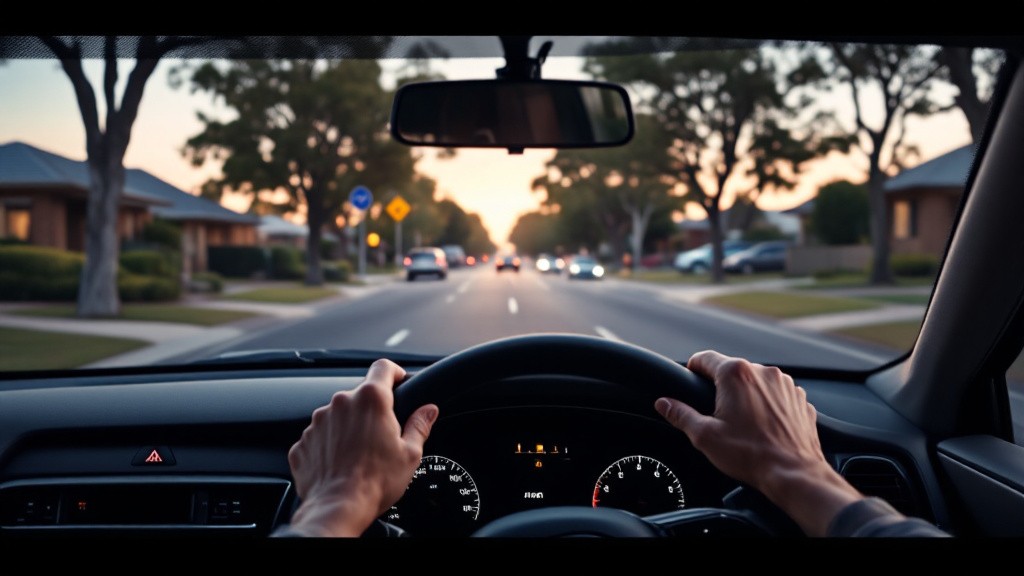
Every question with its answer, side by side
A study set shows you the question and the answer together. There is no score, no clock and nothing hidden, which makes it the right thing to read before you have ever sat a test, and the right thing to read calmly the night before one. It is also the easiest kind of revision to fool yourself with, so the method in the next section matters more than the time you put in. The real Driver Knowledge Test is 45 questions, set by Transport for NSW, and it is marked in two parts: 12 of 15 general knowledge and 29 of 30 road safety, with both minimums required. Four wrong in general knowledge, or two wrong in road safety, ends it immediately. Reading is how you meet the rules. A scored set is how you find out whether you kept them.
The slow pass that actually works
Read a subject through once with everything visible, so you meet every rule in plain sight rather than guessing at it. Then go back and do the work: cover the answer, say the rule out loud before you look, and be honest about the difference between knowing it and half recognising it. Mark every question you guessed rather than knew. On the next pass, read only those. A subject is done when you can give the rule from memory, not when the right option looks familiar on the screen. Reading this way is slower and it exposes the gaps that recognition hides, which is the entire point. The real test rewrites the same rule into wording you have not seen, and recognition does not survive that.
- 1
First pass, everything visible
Go through the subject with every answer visible, no covering up yet.
- 2
Hide it, then state the rule
Out loud, before you look. The rule itself, not the letter of the option.
- 3
Flag what you guessed
Flag anything you guessed, however close you were, and move on.
- 4
Second pass, marked ones only
Re-read only what you flagged. Everything else has already earned its place.
Which car subject to read first
Twelve car subjects are laid out on this page, holding 366 questions between them, each one presented as question and answer to read rather than a scored drill. Read the biggest subject first, while your attention is fresh. General Knowledge is the largest at 82 questions and it rewards two or three sittings rather than one long one. Work down by size from there, and leave the shortest subjects for the end of a session, when you want something you can finish. Bicycle Safety and Bribery & Cheating hold three questions each. They take minutes and they are the easiest rules on the page to never read at all, so do them on a night when you have nothing left in the tank. Every subject and its question count is listed on car practice if you want the full picture before you choose. Open a subject below and start reading.
Alcohol Drugs
Bicycle Safety

Bribery & Cheating
Fatigue Defensive Driving
General Knowledge
Intersections
Negligent Driving
Pedestrians
Seat Belts Restraints
Speed Limits
Traffic Lights Lanes

Traffic Signs
Recognising an answer is not knowing a rule
Reading alone has one trap, and it catches careful people. You begin recognising the correct option instead of knowing the rule behind it, and recognition collapses the moment the wording changes. The test for it is simple: sit the same subject as a scored set the next day. If the rule holds when nothing on the screen is showing you the answer, you know it. If it does not, you were recognising, and the subject needs another slow pass. On the real test, readiness is not a feeling either. It is your last two mocks coming back clear in both sections, because a pass needs both section minimums and the test ends early at four wrong or two wrong. If a scored set drops below that in either section, go back to the reading rather than straight to another mock.
Where the handbook beats a question set
The Road User Handbook, published by Transport for NSW, is the companion read for these sets. The handbook gives you the reasoning behind a rule: why a give-way order exists, what a sign is protecting, how a speed limit relates to the road it sits on. A rule you understand survives a change of wording. A rule you memorised does not. The study sets give you what the handbook cannot. They show the exact shape the question takes on the day, the wording, and the wrong options you have to tell apart under pressure. So read the handbook chapter for a subject first, then read that subject's set, and the two lock together. The handbook explains the rule and the set shows you the trap. Reach for the handbook whenever a question feels arbitrary and you cannot see why the right answer is right, because that is the gap only the reasoning fills.
Turning the reading into a score
Reading is the first pass, never the last one. Sit a car practice test to turn it into a score, then move to the 8 mock tests, which put the full 45 questions into one sitting so the day itself holds no surprises. The Hazard Perception Test is a separate step: 15 short videos, $58 for each attempt, with unlimited attempts, and once you pass it the driving test must be passed within 15 months (Transport for NSW). The clips to practise on are at practise the hazard perception clips. The question bank behind every set on this page is NSW-based. The test itself is run by each state's own authority, Transport for NSW in New South Wales, TMR in Queensland, VicRoads in Victoria, the Department for Infrastructure and Transport in South Australia, the Department of Transport in Western Australia, and the MVR in the Northern Territory, so no NSW figure here should be applied elsewhere. If you are sitting it in the Northern Territory, see our Northern Territory page.
Official sources
The rules on this page follow the official requirements published by Transport for NSW Driver Knowledge Test; Driver and rider licence fees. Always confirm current rules and fees with the authority before you book.