
Reading the heavy vehicle bank before you score it
Study questions are the whole heavy vehicle bank for a subject, laid out as question and answer to read rather than to be scored on. They suit two moments. The first is before you have sat anything, when you want to see what the test actually asks. The second is the night before, when you want a fast pass over the things you know are shaky.
The test they prepare you for is the Heavy Vehicle Knowledge Test: 45 questions on road rules and road safety for your licence class, run by Transport for NSW. It is computer based, booked online through myRTA or at a service centre, and it comes in two versions, heavy vehicle rigid for LR, MR and HR and heavy vehicle combination for HC and MC. A test fee applies on each attempt, so check the current amount before you book.
Cover the answer, say the rule
Reading alone is the weakest way to study, and it is the way most people do it. The fix is small: read a subject through once with the answers showing, then go back to the top, cover the answer and say the rule out loud before you look. Being able to recognise a right answer and being able to produce one are different skills, and only the second is any use when the wording changes. Tick anything you guessed, come back to those and nothing else, and call a subject finished when you can state the rule without the prompt in front of you.
- 1
First pass with the answers showing
Work down a subject just to see what it covers.
- 2
Second pass with the answer hidden
Say the rule out loud before you reveal it.
- 3
Tick anything you guessed
A lucky answer counts as a miss.
- 4
Return to the ticked ones only
Everything else is done. Do not re-read it.
- 5
Finish a subject on the rule, not the option
You should be able to state it with nothing in front of you.
- 6
Then make it a scored set
Open turn the reading into a scored practice test and see what survived.
Fourteen truck subjects to read through
Fourteen subjects sit on this page, 365 questions between them, and all of them are free to read.
Each one is laid out as study rather than as a scored drill: the question, then the answer, in order, so you can move at your own pace. Start wherever you are weakest. If you are upgrading from a car licence, that is almost certainly load restraint, combination vehicles and rigid vehicles, because nothing on a car test covers them.
The size of each subject, set by set, is at truck practice.
Alcohol Drugs

Bribery & Cheating
Combination Vehicles
Fatigue Defensive Driving
General Knowledge
Intersections
Load Restraint
Negligent Driving
Pedestrians
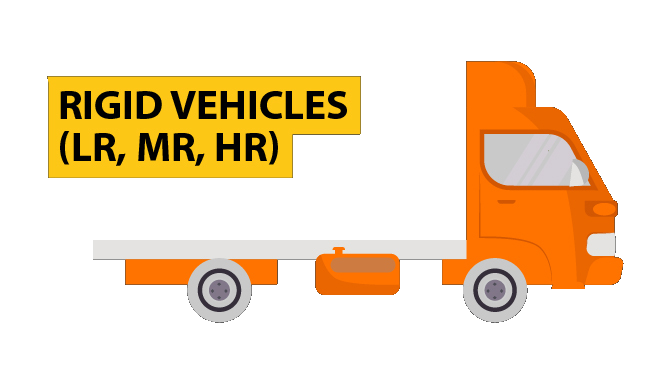
Rigid Vehicles
Seat Belts Restraints
Speed Limits
Traffic Lights Lanes

Traffic Signs
The three documents to read beside them
Transport for NSW names three documents for the Heavy Vehicle Knowledge Test: the Heavy Vehicle Driver Handbook, the Road User Handbook and the Load Restraint Guide. It also publishes an official practice set for the rigid classes, holding 343 questions across its general knowledge, road safety and traffic signs sections.
Read a handbook and a question bank together, because they teach different things. A handbook gives the reasoning behind a rule: why a load has to be restrained a particular way, why a following distance exists at all. That reasoning is what you fall back on when a question is worded in a way you have not seen before.
A question bank gives the shape the question takes: the phrasing, the options, and the one detail that decides the answer. Study only the questions and an unfamiliar wording can throw you. Read only the handbook and you may not recognise the rule when it becomes a question. Together they cover both. The load restraint set at load restraint topic practice is the one to pair with the Load Restraint Guide first.
Recognising an answer is not knowing it
The trap in read-only revision is recognition. You see the right answer, agree with it, and feel ready, without ever having produced it yourself. Nothing in that process asks you to retrieve anything, which is the one thing the real sitting does ask.
The fix is to sit a scored set the day after you read, when the prompt has gone and you have to find the answer rather than confirm it. If the score drops sharply, the reading was recognition. That is useful to know a week out and painful to discover on the day.
Readiness here is two mock tests in a row with no mistakes. That is a clearer target than any percentage, and it is the one you can actually control. The official figure is Transport for NSW's, so check it when you book.
Turning the reading into a result
When the reading holds, convert it. Sit a practice test, then a mock under test conditions at sit a mock under test conditions for the full length and feel of the real thing. Then book your eyesight test. What follows is either the Heavy Vehicle Competency Based Assessment with an accredited provider or the heavy vehicle driving test, and class MC also needs a medical assessment. Transport for NSW sets out that order.
The reading on this page follows the NSW bank. Outside NSW the road rules mostly carry across, but the booking steps and the fee do not, so check those with your own road authority. For the Northern Territory, start at our Northern Territory page.
Hazard perception clips are a separate test and a separate skill. They are at hazard perception clip practice.
Official sources
The rules on this page follow the official requirements published by Transport for NSW Heavy Vehicle Knowledge Test page; Driver and rider licence fees; official rigid practice questions (PDF). Always confirm current rules and fees with the authority before you book.