Where the hazard perception test comes in Queensland
In Queensland the hazard perception test is the gate in front of the practical driving test. Every learner driver must pass it before a practical driving test can be booked, and you need to have held your learner licence for a minimum period before you may sit it. Both conditions come from the Queensland Department of Transport and Main Roads (TMR), on its car hazard perception test page. The test is sat online rather than at a counter, which makes the planning matter more than the travel. Once you have paid you have a window in which to sit it, and the sitting itself is short, so check the current access period and the length on the TMR page before the window closes on you unused. There is one exception worth knowing about. Drivers holding a P1 licence issued under the older rules sit the test to move to P2 instead, and TMR sets out which licences that applies to. If you are a learner today, the test comes before your practical, not after it. So the order is straightforward: learner licence, time on the road, the hazard perception test, then book the practical. If you have not sat the written knowledge test yet, start at the learner knowledge test and come back to the clips once your learner licence is in hand.
The hazard perception test in Queensland
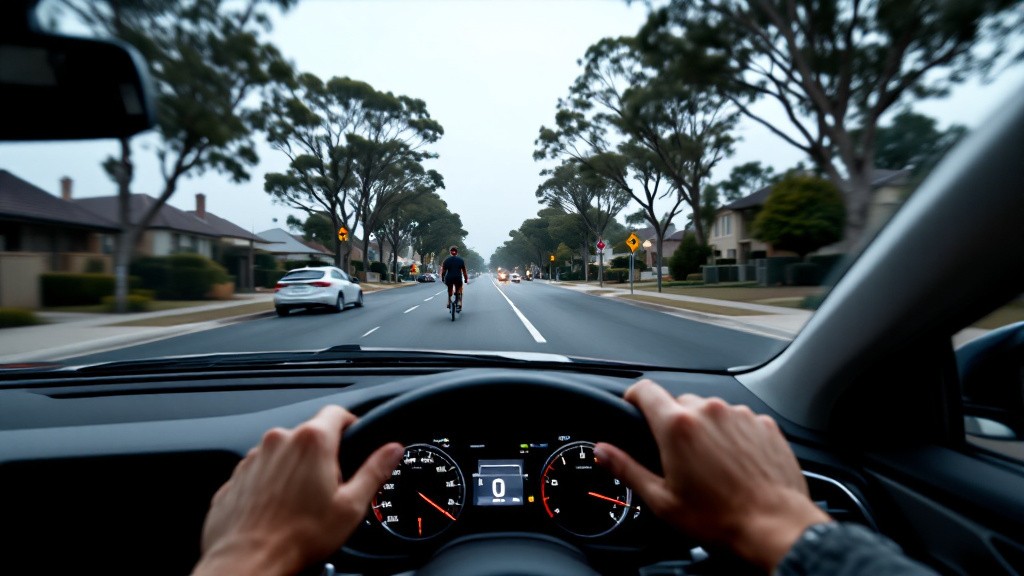
The test shows you filmed traffic scenes from the driver's seat and asks you to respond at the moment it is safe to act. TMR runs it, scores it and decides what counts as a safe response. Part of the skill is knowing when to hold back rather than react. A scene where a car slows and settles back into its lane needs nothing from you, and responding anyway says you are chasing movement instead of reading risk. A developing hazard, such as a car edging out of a side street or a pedestrian turning towards a crossing, gives you a second or two of warning when your eyes are already ahead of the bonnet. The Queensland Department of Transport and Main Roads (TMR) sets the clip count, the pass rule and the fee, and publishes them on its car hazard perception test page. Our clips train the two things the test watches, your scanning and your timing. They are practice scenes, not TMR's own test footage, so use them as rehearsal. The written practice sets on this site are built on the New South Wales question bank, so they drill road rules well; anything Queensland specific is worth checking with TMR.
Sitting it online, in your own time
An online sitting removes the queue and adds a different job: setting yourself up properly. Find a quiet half hour where nobody will walk through the room, and use a device with a screen big enough to see the far side of a junction. A laptop beats a phone for this. Check your connection before you start, not during a clip. Close the other tabs, put the phone face down, and have your identification to hand in case it is asked for. Then treat it like a drive. Sit square to the screen, look through the scene rather than at the middle of it, and let your eyes move to the kerbs, the side streets and the mirrors the way they would on the road. Because the sitting is short, there is no time to warm up inside it. Do one calm run of the free clips on this site an hour before, then stop. Arriving warm is worth more than one last cram.
What the clips ask of your eyes
Hazard perception is about spotting a hazard while it is still developing, not reacting once it has arrived. The clips put you in the driver's seat and watch how early and how accurately you read a scene as it unfolds. Early reading is a habit you can build deliberately. Let your eyes travel ahead of where the car will be in three seconds, then sweep the kerb line, the parked cars, the side streets and the mirrors, and come back to the middle. Most developing hazards announce themselves at the edges of the frame before they reach the centre. There are three ways a response goes wrong, and it is worth knowing which one is yours. Work out which one is yours by running a few free clips cold and noticing the pattern, rather than trying to fix all three at once. Someone who responds too early needs to wait for the evidence; someone who responds too late needs to start scanning sooner. They are different repairs.
Going before the evidence
Responding before anything is actually happening reads as guessing, not judgement; the scene has not yet become a hazard.
Going after the moment
Waiting until the car has already pulled out or the pedestrian is in your path means you have missed the window to act safely.
Going when nothing was coming
Some scenes resolve themselves, and the safe choice is to keep scanning and not respond at all. Acting anyway is a wrong call.
Booking with TMR and sitting the test
Booking and payment are handled by TMR through its own online service. Confirm the current conditions on the TMR car hazard perception test page before you pay, because eligibility and the identification you need are set by the authority and can change. Note the date you paid, because the access window starts there rather than when you first log in, which is easy to overlook. If you are going to be away or into end of term, book it for when you will actually sit down to it. If a sitting does not go your way, TMR sets how soon you may try again and what another attempt costs. Rather than rebooking the same afternoon, spend a few days on the clip library here working on the one mistake that caught you, then go back in.
Five sessions, then sit it
Five short sessions on the free clips at Start free clip practice, each one aimed at a different kind of scene. No score targets. The aim is an earlier, calmer read by the last session. Keep each session to fifteen or twenty minutes and leave a day between them where you can. Because the Queensland sitting happens online whenever you choose, you can line the last session up with the day you intend to sit it and go in warm rather than cold.
- 1
Session 1: a cold read
Run a handful of free clips with no warm-up, just to see where your timing sits today.
- 2
Session 2: intersections and merges
Work the scenes where another driver is deciding whether to come out or come across. These are the ones that punish a late scan.
- 3
Session 3: pedestrians and parked cars
Kerb-line scenes. A car door, a child, a van that hides the footpath. Most of these announce themselves at the edge of the frame.
- 4
Session 4: when holding back is the answer
Clips where nothing develops. Practise leaving them alone, because responding anyway is a wrong call.
- 5
Session 5: one run at pace, then book
A complete run without pausing, then sit the real one while the habit is fresh.
Official sources
The rules on this page follow the official requirements published by Queensland Department of Transport and Main Roads (TMR). Always confirm current rules and fees with the authority before you book.