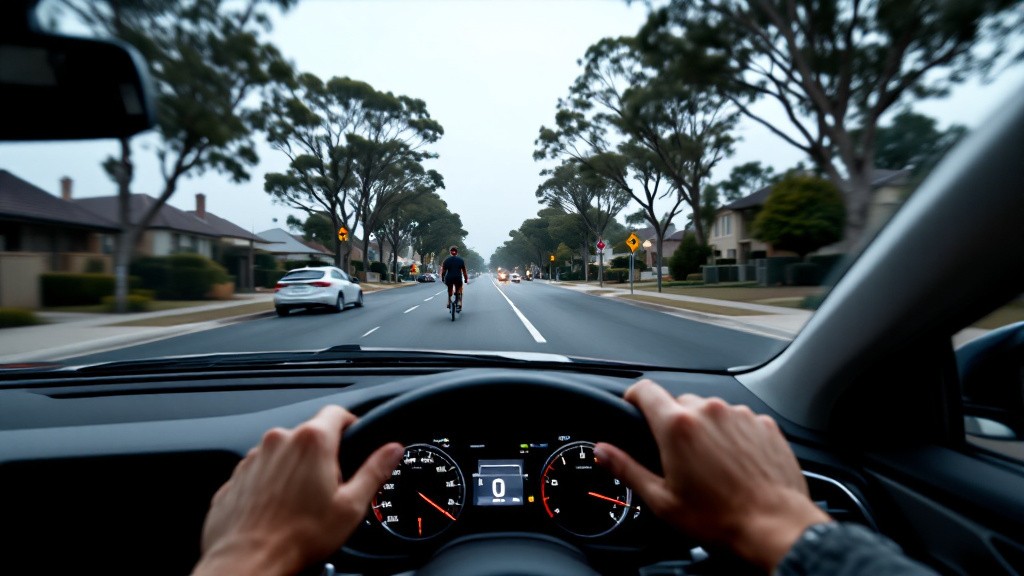
The hazard perception test in Western Australia
The hazard perception test asks you to watch a filmed traffic scene from the driver's seat and respond at the moment it is safe to act. The Western Australian Department of Transport (DoT) runs it, scores it and sets its rules. Acting is not always responding. Sometimes the safe choice is to hold back and let a situation clear, and that judgement is part of what is being read. The scenes play out the way a real road does: a parked car's door starting to open, a pedestrian turning towards a crossing, a side street feeding traffic into your lane. Your job is to see it early, not to react once it has arrived. The Western Australian Department of Transport (DoT) sets the clip count, the pass rule and the fee, and publishes them on its hazard perception page, along with where this test sits for your licence class and what you need to clear before it. The hazard clips here train your scanning and your timing. They are practice scenes, not DoT's own test footage, and no practice clip matches the real scenes exactly. The written practice on this site is built on the New South Wales question bank, so it drills road rules well without being written to a WA question set. If the written stage is still ahead of you, start at the learner knowledge test and come back to the clips afterwards.
Where a response goes wrong
The clips test whether you can spot a hazard developing, not whether you can react once it has arrived. A good response reads the scene, a cyclist drifting towards your door line, a ball rolling out before the child does, brake lights two cars ahead, and acts while there is still room to act calmly. There are three ways a response goes wrong. Too early: you respond to something that was never going to become a hazard, which shows you are reacting to movement rather than reading it. Too late: you wait until the danger is on top of you, which on a real road is the near miss you wanted to avoid. And responding when the safe choice was to hold back, treating every moving thing as a threat instead of letting a clear situation stay clear. A calm, early scan beats fast fingers every time, because what is being judged is your reading of developing risk, not your reflexes. Run a few free clips cold and work out which of the three leans your way, then repair that one rather than all three at once.
Jumping at movement
Responding before anything is really developing, a sign you are guessing rather than reading the scene.
Missing the window
Waiting until the hazard is on top of you; on a real road that is the near miss.
Answering a clear scene
Treating a clear, settling situation as a threat instead of letting it stay clear.
Training the hold-back decision
The hold-back scenes are worth practising on their own, because they ask you to do the opposite of what nerves want. A car slows and settles back into its lane. A cyclist holds a steady line well clear of your door. A gap stays comfortable. None of those needs anything from you, and responding anyway is a wrong call. The habit to build is a short pause for evidence. See the movement, name what would have to happen next for it to become a hazard, and respond only when the scene starts to show it. Said out loud in practice, that sounds like: the car is slowing, it is holding its lane, nothing yet. Then practise the pair. Run a developing scene and a settling scene back to back so your eye learns the difference rather than treating all movement as risk. If you can leave a clear scene alone, the early scan is usually there too, because both come from reading rather than reacting.
- 1
Watch the scene build
Let your eyes travel ahead of the car, then sweep the kerbs, the parked cars and the side streets.
- 2
Name what would make it a hazard
Say what would have to happen next. It keeps you reading the scene instead of reacting to movement.
- 3
Respond when acting becomes safe
Not a second before the evidence is there, and not after the danger has already arrived.
- 4
Leave the clear scenes alone
A settling car or a steady cyclist needs nothing from you. Holding back is an answer in itself.
Practise the WA hazard clips free on this site
Three stages, and the first costs nothing. The clip library is at Start free clip practice: run a dozen scenes cold and see which way you lean, early, late, or responding to movement that was never a threat. Premium practice comes with the course at the premium practice course. It opens more scenes and lets you replay the same judgement, so a hold-back call you misread once can be run again until the timing settles. Already hold the course? Sign in at open your account and your runs pick up where you stopped. Work the free clips for a few days before you decide. Steady timing needs nothing more than repetition. One kind of scene catching you every single run is what the extra replays are there to fix.
Scanning habits that carry into real driving
The useful part of clip practice is that the habit does not stay on the screen. The scan you build for the test is the one that keeps you out of trouble on a wet Thursday afternoon in traffic. Practise watching the whole frame. Eyes ahead of where the car will be in a few seconds, then the kerb line, then the parked cars, the side streets and the mirrors, then back to the middle of the road. Most hazards announce themselves at the edges before they reach the centre. Give yourself a running commentary while you practise. Naming what you see, out loud, slows the panic and speeds the reading: parked van, door could open, child on the kerb, car waiting to turn. On the day you will not need the words, because the pattern will already be there. And practise at the times you actually drive. A scene read at night or into low sun is a different job from the same scene at midday. Ten minutes of this, done honestly, is worth more than an hour of clicking through scenes on autopilot. The aim is that the scan runs without you having to ask it to.
Booking through DoTDirect and on the day
Booking is made through DoTDirect, the Western Australian Department of Transport (DoT)'s online portal. Confirm the current conditions there before you pay, because eligibility, the identification required and the fee are the authority's to set and do change. On the day, bring the identification the authority lists for your booking. Turning up with the wrong document is the easiest way to lose a slot, and it is the one part of the day entirely within your control. Give yourself time to settle before you start. The test rewards a calm, early scan, and walking in late works directly against it. Treat the clips you have run here as the rehearsal that makes the real scenes feel ordinary. If a sitting does not go your way, DoT sets how soon you may try again. Spend the gap on the hold-back scenes and on the pattern that caught you.
- 1
Book through DoTDirect
The Western Australian Department of Transport (DoT) online portal.
- 2
Confirm requirements first
Check eligibility and ID with DoT before you pay.
- 3
Bring the right ID
Arrive with the identification the authority lists.
Four days on the clips
Four focused days is enough to turn a shaky scan into a habit. Each day points at the clip library at Start free clip practice, and none of them has a score to chase. Keep the sessions short. Fifteen or twenty minutes holds your full attention, and attention is the whole skill here. Spread the days out when life gets in the way, and if you miss one, carry on from where you stopped rather than doubling up. Leave the fourth day light so you book your sitting warm rather than worn out.
- 1
Day one: a baseline run
Run a set of free clips to see where your timing sits right now, before you try to change anything.
- 2
Day two: the scene types you miss
Go back to the kinds of scene that caught you on day one and run them until the early scan arrives by itself.
- 3
Day three: holding back
Only the clips that ask you to do nothing. Leaving a clear scene alone is a skill of its own.
- 4
Day four: one run without stopping
A single complete run at real pace, then book through DoTDirect while the habit is fresh.
Official sources
The rules on this page follow the official requirements published by Western Australian Department of Transport (DoT); DoTDirect. Always confirm current rules and fees with the authority before you book.