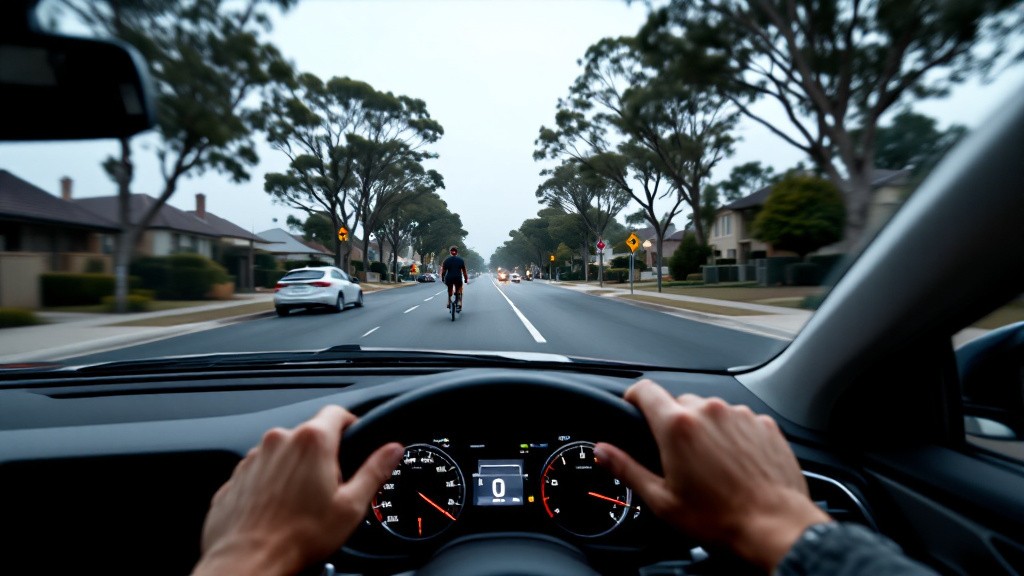
The hazard perception test in Victoria
The hazard perception test asks you to watch a filmed traffic scene from the driver's seat and respond at the moment it is safe to act. Sometimes the safe response is to do nothing at all, which is the part that is easiest to miss. VicRoads runs the test, sets its rules and scores it. You watch the road the way you would through a windscreen, and you react when a real driver would, not a second before. The skill is judgement under live conditions: reading a scene early enough that the response comes smoothly instead of as a snatch once the danger has arrived. VicRoads sets the clip count, the pass rule and the fee, and publishes them on the VicRoads hazard perception page, so check those details there before you book. The clips on this site train scanning and timing. They are practice scenes rather than VicRoads's own test footage, so no clip here matches a scene you will be scored on. The written practice on this site is built on the New South Wales question bank, so check anything Victoria specific with VicRoads.
Online or at a service centre: how to choose
Victoria lets you choose. You can take the hazard perception test online or in person, and VicRoads explains both on its hazard perception page. Online suits a learner who is comfortable with a browser and has somewhere quiet to sit. There is no travel and no waiting room, and you can pick a time when the house is empty. The trade is that the setup is yours to get right: a laptop rather than a phone, a connection you have checked, and half an hour where nobody will interrupt you. In person suits a learner who would rather not think about any of that. The screen is set up for you, somebody is there if something goes wrong, and the trip itself puts you in test mode before you sit down. Nerves are worth being honest about here. If you know you read a screen badly with people around, go online. If you know you will be checking your phone at home, go in. The clips you practise here run the same either way.
Before your drive test: where the HPT fits
The hazard perception test has to be completed before you can take the drive test. That is the fixed point in the Victorian sequence, and VicRoads publishes it on its hazard perception page. To sit it you need a current Victorian learner permit and to have reached the minimum age VicRoads sets. So the clips test is not a first step: it comes after the written knowledge test has earned you the permit, and while your supervised driving is building up. The practical drive test is the step after. Because the drive cannot be taken until the clips test is behind you, it pays to clear it well before you want a drive date, rather than discovering the order at the point of booking. If you are still at the written stage, start at the learner knowledge test practice for how the knowledge test works, then practise the questions at practise the written test. Rules first, then timing: the clips make far more sense once you know what a safe gap looks like.
- 1
Learner permit first
The written knowledge test earns your Victorian learner permit. You can prepare for it with the question practice on this site.
- 2
Then the hazard perception test
Sat online or in person, once you hold a current learner permit and meet the minimum age VicRoads sets.
- 3
Then the drive test
The on-road drive test comes after the hazard perception test, and it is booked through VicRoads.
Three ways a response goes wrong
The clips test one skill: spotting a hazard while it is developing rather than reacting once it has arrived. Three patterns cover most of what goes wrong, and each needs a different repair. Going early means you are reacting to movement. The repair is evidence: wait until something in the scene tells you it is becoming a hazard, then act. Going late means the scan started too slowly. The repair is where you look. Let your eyes travel ahead of where the car will be in a few seconds, sweep the kerbs, the parked cars and the side streets, then come back to the middle of the road. Responding when you should hold back means you are hunting. The repair is patience with clear scenes: a car that slows and settles, a cyclist holding a steady line, a gap that stays comfortable. Those scenes want nothing from you. Run a few clips cold and work out which of the three is yours. Fixing one pattern deliberately beats fixing all three at once.
The guess
You respond to a car, a pedestrian or a cyclist that is not yet a hazard. Seeing something is not the same as judging when it becomes a risk; an early response shows you are reacting to movement rather than reading the scene.
The late read
You click after the danger has fully developed, when a real driver would already be braking or steering. A late response means your scan started too slowly to leave room to act safely.
The hazard that was never one
Some scenes are safest when you do nothing: the gap is fine and the other road user is behaving predictably. Responding anyway shows you are hunting for hazards instead of judging the real level of risk.
Booking through VicRoads
Book the Victorian hazard perception test through VicRoads, choosing either the online sitting or a service centre appointment. Confirm the current eligibility and the identification you need on the VicRoads hazard perception page before you pay, because those conditions are theirs to set and do change. If you are going in person, arrive early and bring the identification listed for your booking. Give yourself a few minutes to settle before you sit down, because the test rewards a calm, early scan and walking in flustered works against you. Rescheduling and cancelling go through the same place you booked, under the notice rules that apply at the time. If a date moves, keep the clip practice going so the new sitting still finds your eye warm. It is worth booking a slot a week or so ahead rather than for tomorrow. That leaves room for a week of practice, and it means a change of plan costs you a message rather than a fee.
Three sessions is enough
You do not need a week of this. Three honest sessions on the clip library at Start clip practice will move a shaky scan into a habit, provided they happen on different days and in this order. Twenty minutes a session is plenty, and short is the point: attention is the whole skill, and an hour of clips teaches you to skim. Leave at least a day between sessions so the pattern settles in the gap. Book your sitting for the day after the third session rather than straight after it. VicRoads lets you take the test online or in person once you hold a current Victorian learner permit, so you can choose the quieter option.
- 1
First session: where your timing sits
Run a set of free clips with no preparation. This is a starting point, not a result to judge yourself on.
- 2
Second session: scene type by scene type
Take the kinds of scene one at a time, intersections, then merging, then pedestrians, until the early scan stops being deliberate.
- 3
Third session: one unbroken run
A single run at real pace, no pausing, including the clips that ask you to hold back and do nothing.
Official sources
The rules on this page follow the official requirements published by VicRoads hazard perception page. Always confirm current rules and fees with the authority before you book.