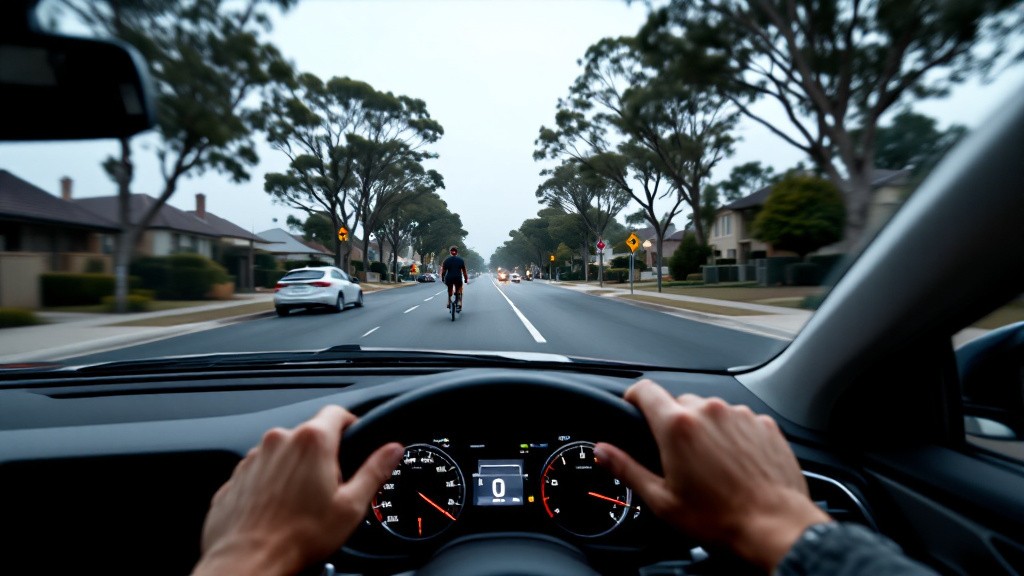
The hazard perception test in South Australia
The test asks you to watch a filmed traffic scene from the driver's seat and respond at the moment it is safe to act, and sometimes to hold back, which is the part that is easy to miss. The South Australian Department for Infrastructure and Transport (DIT) runs it and sets its rules. The scenes play out as ordinary driving: a car edging from a side street, a pedestrian near a crossing, a bus pulling away from the kerb. Your job is to read the scene early and respond when acting becomes safe, not a second before and not a second after. DIT sets the clip count, the pass rule and the fee, and publishes them on its hazard perception test page, so check them there before you book. The clips here train scanning and timing. They are practice scenes, not DIT's own test footage, so treat them as rehearsal rather than a preview. The written practice on this site is built on the New South Wales question bank, which is openly published. The road rules carry across well, and anything South Australia specific is worth checking with DIT.
The step from your learner's permit to P1
In South Australia the hazard perception test is the step that takes you from a learner's permit to a P1 provisional licence. That is what it is for, and it explains the timing of everything around it. It can also be completed before you pass your practical driving test, so the two are not locked together. A learner who is confident on a screen but still building supervised hours can get the clips test done early and have one less thing waiting at the end. A minimum period on your learner's permit applies first, and DIT sets how long that is for your age. The test is sat online or in person at a Service SA centre, so you can pick whichever suits you. The practical driving test, or an approved course in its place, is the other half of the move to P1. DIT publishes the full sequence on its licensing pages, so read the order that applies to your age before you plan dates, and get the clips test out of the way while your logbook is still filling.
Judgement, not reaction speed
The test measures whether you can spot a hazard developing rather than react once it has already arrived. A good response reads the scene early: the parked car with brake lights on, the child near the kerb, the gap closing in traffic, and you act while there is still room to act calmly. There are three ways a response goes wrong, and it is worth deciding which one is yours. Responding too early, before the hazard is genuinely developing, reads as guessing. Responding too late, once the danger is on you, reads as missing it. Responding when the safe choice was to hold back, because nothing has actually developed, reads as over-reacting. A calm, early scan beats fast fingers every time, because what is being judged is judgement, not reflex. Build it by watching the same kinds of scene again and again until your eyes go to the right place without being told: ahead of the car first, then the kerbs, the side streets and the mirrors, then back to the middle. DIT scores the real test. Your practice is about arriving with a trained eye so the scoring takes care of itself.
Run the clips free, as often as you like
The clip library lives at Start free clip practice. Run the free clips cold, then run them again; repetition is what turns early scanning into a habit rather than an effort. Premium practice is sold as part of the course and is set out at see what the course includes. It adds more scenes and more replays of the same judgement, so a decision you misread once becomes automatic instead of staying a one-off. If you already hold the course, sign in at sign in and carry on from your last run. Start with the free clips for a few days and look at what is still catching you out before you decide whether the course adds anything for you. If your timing is already steady, repetition is all you need. If the same kind of junction keeps fooling you, the extra scenes and replays are where that gets fixed. There is no score to beat in any of it. Judge yourself on how early and how steadily you respond, and on whether the scenes that want nothing from you are starting to look obvious.
The free scenes
Open the clip library and start scanning filmed scenes straight away. Replay any clip as many times as you need to fix your timing.
The course clips
The premium clips, sold as part of the course, add more scenes and more replays of the same judgement so a tricky decision becomes automatic. Open see what the course includes to see what the course includes.
Picking up a run
If you already hold the course, sign in at sign in to pick up your premium clips where you left off.
Where it sits beside the written knowledge stage
The written knowledge test comes first in South Australia: you pass it to get your learner's permit and start logging supervised driving. The hazard perception test comes later, because it asks you to read live traffic the way a driver with some road time does. That makes the two kinds of preparation different jobs. The written test rewards recall of rules, signs and distances. The clips reward reading a scene early. Doing them in that order is easier, because once you know what a safe gap looks like on paper you can see it coming in a clip. If you are still at the written stage, start at the learner knowledge test for how the knowledge test works, then practise the questions at practice test 1 until the rules stop needing thought. Come back to the clips once that is true and the timing work will land much faster.
Booking through mySA GOV and on the day
Booking goes through mySA GOV or a Service SA centre, depending on whether you are sitting the test online or in person. Check the current conditions with DIT before you pay, because eligibility and the identification you need are the authority's to set and do change. If you are going in person, bring the identification listed for your booking and arrive with time to settle. If you are sitting it online, find a quiet half hour, use a laptop rather than a phone, and check your connection before you begin rather than during a clip. If a sitting does not go your way, rebook through the same channel. Spend the days in between on the clip library here, working on the one pattern that cost you.
- 1
Book through mySA GOV / Service SA
Arrange your test through the official booking channel rather than a third party.
- 2
Confirm the current requirements first
Check the current booking rules, eligibility and fee with the South Australian Department for Infrastructure and Transport (DIT) before you pay.
- 3
Bring the right identification
Arrive with the identification the authority lists, and allow time to settle before you start.
Work the clips in this order, not by the calendar
Order matters more than how many days you spread it over. Work the free clips at Start free clip practice by scene type, in the sequence below, and move on only when the current kind stops catching you. No score to chase. Fifteen to twenty minutes at a time is enough, and that is deliberate: a short run holds your attention all the way through, where a long one teaches you to skim. Keep the last stage light so you arrive fresh rather than drilled. South Australia lets you sit the test online or in person at a Service SA centre, so pick whichever lets you start calm.
- 1
Start cold, with no warm-up
One run at Start free clip practice before you have thought about any of this, so you know which way you lean.
- 2
Give-way and merging scenes
The clips where someone else is deciding whether to pull out or come across. A late scan costs you most here.
- 3
Pedestrians, cyclists and parked cars
Kerb-line work at Start free clip practice. The evidence usually appears at the edge of the frame before anything reaches the middle.
- 4
The clips that want nothing from you
A settling car, a steady cyclist, a comfortable gap. Practise leaving them alone until that feels like an answer rather than a miss.
- 5
One full run before you book
A complete run at Start free clip practice without stopping, then book through mySA GOV or a Service SA centre.
Official sources
The rules on this page follow the official requirements published by South Australian Department for Infrastructure and Transport (DIT); mySA GOV. Always confirm current rules and fees with the authority before you book.