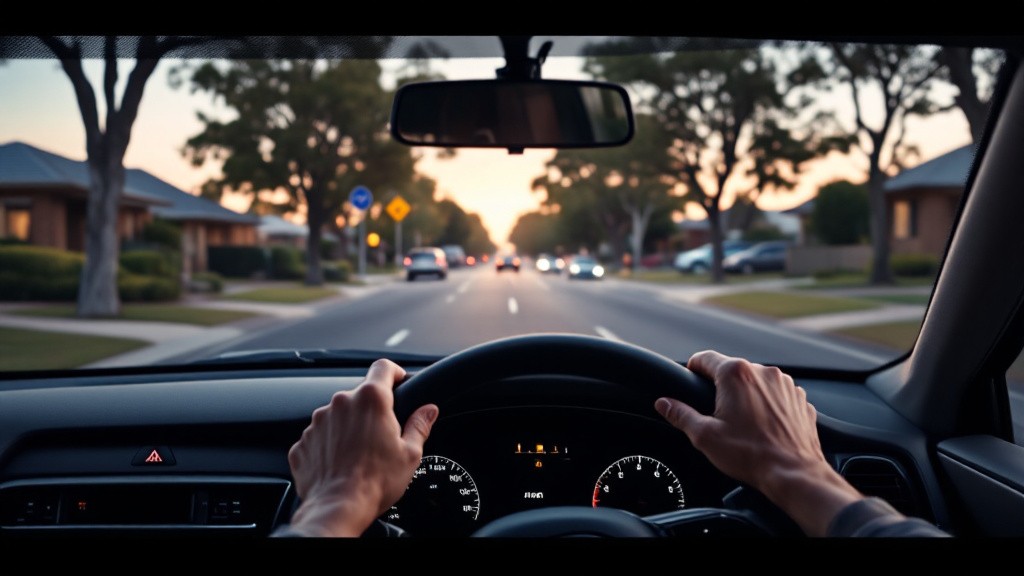
The one thing both countries have in common
Neither Australia nor Canada runs a single national driving test. Australia licenses by state and territory; Canada licenses by province and territory. That makes "the Australian test" and "the Canadian test" both shorthand — in reality each one is a set of separate systems, so any fair comparison has to be made authority by authority rather than country to country. In Australia the authorities you would deal with include Transport for NSW, VicRoads in Victoria, Transport and Main Roads (TMR) in Queensland, the Department for Infrastructure and Transport in South Australia, the Department of Transport in Western Australia, and the Motor Vehicle Registry (MVR) in the Northern Territory. In Canada the equivalent body is each province's own transport or insurance authority. Hold that in mind as you read: a figure that is true in New South Wales is not automatically true in Victoria, and a rule that applies in Ontario may not apply in British Columbia. Comparing the two countries only works once you compare like with like.
Australia: the NSW knowledge test
In New South Wales the Driver Knowledge Test is 45 questions, per Transport for NSW (2026). To pass you need both section minimums: 12 of 15 in general knowledge and 29 of 30 in road safety — reaching 41 of 45 overall is necessary but not enough on its own. The sitting ends immediately if you get 4 wrong in general knowledge or 2 wrong in road safety. You can sit it in person from 16 years of age at $58 each attempt. Online, you may enrol from 15 years and 11 months; that path is an interactive 4–6 hour self-paced course plus a final test, costs $58 for unlimited attempts, and a failed final test can be retaken after 12 hours. The learner licence itself is $32. The Hazard Perception Test is 15 short video clips at $58 each attempt with unlimited attempts, and a pass stays valid for 15 months for the driving test. The on-road driving test is $72 (inc GST) each attempt. These are New South Wales figures — every other state and territory publishes its own.
Canada: the same shape, a different map
Canada licenses drivers provincially and territorially, not nationally — so there is no single "Canadian test" to quote. What is common across provinces is the shape: a graduated system that starts with a written knowledge stage, moves to a supervised driving stage, and then requires one or more road tests on the way to a full licence. The stage names differ. In Ontario the first stage is the G1, which is purely an Ontario naming — other provinces label their stages differently. For the provinces readers most often ask about, the authority to check is Ontario's Ministry of Transportation, British Columbia's ICBC, Alberta Transportation, Quebec's SAAQ, Saskatchewan's SGI, and Manitoba Public Insurance. Each publishes its own ages, question counts, pass marks and fees on its own licensing pages, and those are the only reliable source for a figure. The honest takeaway is structural: Canada mirrors Australia in that the rules you actually face depend on which sub-national authority you deal with, not on the country printed on the map.
Written knowledge stage
A rules-and-signs test — the entry point in every province.
Supervised driving stage
A learner period driving with a qualified supervisor.
Road test stage
One or more on-road assessments toward a full licence.
What a comparison can honestly say
A fair comparison describes structure, not a winner. Both countries use a graduated licensing system. Both begin with a knowledge test on road rules and signs before any solo driving. Both require a period of supervised driving before a learner can earn a full, independent licence. Both attach conditions after that first pass — the provisional or graduated restrictions do not disappear the moment you qualify. And both are administered sub-nationally, which means fees, minimum ages and test formats vary within each country as much as they vary between the two. That last point matters most for anyone trying to rank one country against the other: the gap between New South Wales and Victoria, or between Ontario and British Columbia, can be wider than any neat "Australia versus Canada" headline. So the useful conclusion is not that one is easier, faster or cheaper — it is that both ask you to pass a knowledge stage, prove supervised experience, and then drive under conditions, with the exact numbers set by whichever authority governs where you live.
If you hold a Canadian licence and are moving to Australia
The authority in the Australian state or territory you move to decides whether your overseas licence converts, whether you must sit a test, and how long you may keep driving on your Canadian licence before you have to switch. There is no single national rule to quote, and no fixed period that applies everywhere — if you land in New South Wales, Transport for NSW sets and publishes those conditions; move to Victoria instead and VicRoads sets its own. Check the authority for your destination state directly, because the requirements, the recognised licence classes and any grace period are theirs to define, not something an outside site should state for them. The same logic runs in reverse: if you move from Australia to Canada, the province you settle in decides what your Australian licence is worth and publishes its own rules. In both directions the pattern is identical — the sub-national authority holds the answer, and that is the page you want to be reading before you drive.
Practise the Australian test before you sit it
Free, no sign-up practice for the Australian knowledge test lives on this site. The car stream has 12 topic sets (366 questions), 9 practice tests of 45 questions (405) and 8 mock tests of 45 (360). The motorbike stream has 12 topic sets (549), 13 practice tests (585) and 8 mocks (360). The heavy vehicle stream has 14 topic sets (365), 9 practice tests (405) and 8 mocks (360). For hazard perception, the clips sit at hazard perception clips. The question bank is NSW-based, so it maps most directly onto the New South Wales knowledge test — use it to learn the road rules and signs the test covers, then confirm the exact figures for your own state with its authority. Running the mock tests until they come back clean is the most honest readiness signal you have before you book the real sitting.
Car
Topic sets, practice tests and mocks for the car knowledge test.
Motorbike
Topic sets, practice tests and mocks for the rider knowledge test.
Heavy vehicle
Topic sets, practice tests and mocks for the heavy vehicle knowledge test.
Official sources
The rules on this page follow the official requirements published by Transport for NSW Driver Knowledge Test; Transport for NSW driver and rider licence fees; Transport for NSW. Always confirm current rules and fees with the authority before you book.